Showing posts with label encaustic conference. Show all posts

Sunday, May 25, 2014

BRICOLAGE: Art With Dimensional Materials - Nick Cave

Nick Cave is another one of the artists I will be including in my talk at the Eighth Annual Encaustic Conference in Provincetown. The conference, founded and directed by Joanne Mattera, runs Friday, June 6, through Sunday, June 8th this year. Here is the link that gives all the details.

A button-covered soundsuit with an abacus faceguard by Nick Cave

My talk on the Friday is entitled, Bricolage: Art With Dimensional Materials, and I will be presenting the work of more than 15 artists. I have chosen a range of work, most of it wall mounted, to illustrate that bricolage can bring art to a place somewhere between two and three dimensions. However, I have also added a couple of sculptors to the mix of artists because the technique of bricolage can be used with freestanding, fully-dimensional works.

For me, the important thing about bricolage as a technique or process is that found objects and materials lose their original identities and are transformed into new creations. Bricolage often involves destruction and revisioning, unlike assemblage, in which found objects retain their original identities.

Nick Cave is a unique artist who exists between worlds: he's a sculptor, a clothing designer and a dancer. A website describes him as "part Alexander McQueen and part Andy Warhol." Nick Cave's first soundsuit was created from twigs he gathered in a park. Initially he thought of it as a stationery sculpture, but when he put it on his body and moved with it, the twigs hit against each other and created sounds that reflected his motions. The suit also gave him a new identity without racial, gender or national origin characteristics

Click here for a short video from the New York Times where Nick Cave demonstrates the sounds that two soundsuits make - the first one a loud and clanky collection of spinning tops and noisemakers, the second a soft, swishy, swirl of long fibers.

Cave's soundsuits transcend other boundaries in that they may be worn for public performances and also exhibited in museums and galleries as artworks. Nick Cave's New York gallery is Jack Shainman (also home to the great Anatsui) where soundsuits list for $45,000 and up. The suits are designed by Cave using a vast collection of objects and materials gathered at thriftshops, tag sales and wholesalers.

Last year the Denver Art Museum presented Sojourn, an extensive exhibition of works by Nick Cave. Here are two videos provided by the museum. The first one is a tour of the exhibition narrated by Nick Cave. The second shows the labor-intensive installation process.

Denver Art Museum tour of Sojourn - 5:34


Installation - 2:52


Thursday, May 22, 2014

Bricolage: Art With Dimensional Materials - Joan Snyder

Joan Snyder - My Life - 1996, oil, straw, velvet, silk and plastic
grapes on linen, 48" x 54"

For this year's Annual Encaustic Conference, the eighth consecutive year for this wonderful conference, held in Provincetown, Massachusetts at the Provincetown Inn, the dates are Friday, June 6, through Sunday, June 8th. Here's the blog link that gives all the details.  I will be giving a talk on Friday, June 6th, entitled, Bricolage: Art With Dimensional Materials. I am presenting the work of more than 15 artists who transform objects and materials into bricolage works - both wall mounted and free standing.

Several of the artists I am including in my talk have videos and other online presences, so I intend to feature some of them in this blog.

I am very pleased that Joan Snyder, wonderful painter, will be among those I am featuring. Here's a 10-minute video by James Kalm of Joan Snyder's 2010 show at Betty Cunningham Gallery. From this video you can really get a sense of the dimension she adds to her paintings with materials such as textiles, paper mache, flower parts, mud, straw, feathers, herbs, and many more.

Note that Joan Snyder will also be teaching a week-long master workshop at Castle Hill Center for the Arts in Truro, September 8 - 12, entitled The Anatomy of Your Painting. And finally, here is Joan Snyder's website where you can see more of her work.

Sunday, April 21, 2013

Thinking About Bricolage

I am gearing up for my two-day workshop on May 28 and 29 at Castle Hill Center for the Arts in Truro, Mass. in conjunction with the Seventh Annual International Encaustic Conference. This year, for the first time, Bricolage: Making Fine Art With Found or Recycled Materials and Encaustic will be a two-day workshop preceding the encaustic conference. I have expanded it to two days to give students more time to think about the concept of bricolage, make examples of work and present them to the class for discussion and critique. Having the opportunity to make several examples results in a big difference to students. I saw this last summer when I was a visiting artist at R&F Paints and able to extend the bricolage workshop to three days.

There are three places left in the class and you can sign up here.)

What is bricolage, anyway?

Last year I did some thinking about collage, assemblage and bricolage and defined for myself what the differences were between three types of art that use found, recycled or invented objects.

CollageWorks made using paper or fabric and glue, or also using wax as glue. Collage is basically two dimensional in this more traditional definition.

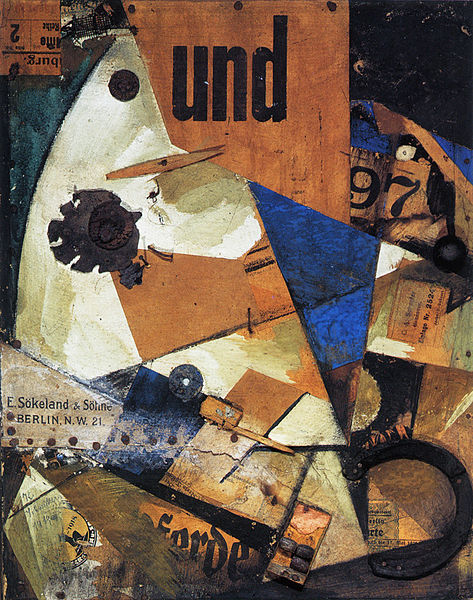
Picasso and Braque were two early practioners of this genre, but perhaps the most famous 20th century "collage artist" was Kurt Schwitters. Note that gluing paper into the composition is probably the most important aspect of collage but paint, charcoal and other additions may also be incorporated.


Kurt Schwitters, "Das Unbild" 1919

Collage can also be built up into more dimensionality with the addition of more and thicker paper or even other objects. Take a look at this interesting review of a current show of 20th century works in collage.

AssemblageWorks made with found objects that are not changed but are brought together into a new whole. The objects retain their original/unique identity and the new work emphasizes the connection between the found objects. (For example, works by Bettye Saar)

Bettye Saar, "Sunnyland (On the Dark Side", 1998 courtesy of the Brooklyn Museum

Bettye Saar is well-known for her assemblage (and collage) works that reference racism and feminism. I have been a fan for some years. In 2011 I visited a show called "Cage" at her New York Gallery and wrote a blogpost about it along with the work of her daughters, Lezley Saar and Alison Saar. You can see more examples of her work by clicking on the blogpost link.

More Assemblage
Joseph Cornell was perhaps the most famous artist to work mostly in assemblage by bringing together found parts, pieces and images and usually putting them into boxes that formed little worlds of their own.


Joseph Cornell, "Hotel Eden," ca. 1945, courtesy National Gallery of Canada, Ottawa.

Unlike Saar's more topical work, Cornell evoked an air of mystery with his strange juxtapositions and hidden allusions.

While Saar and Cornell are two of the most accomplished artists using this type of construction for their work, many unschooled and/or hobbyist artists are also drawn to the use or re-use of things they may have at hand. Some of these have a charming folk art quality, but others fail to achieve more than a desultory bringing together of disparate objects.

What Makes It Fine Art?
I think what separates "art" from "hobby" in creating assemblage works in particular is attention to formal elements of art making. This may be as simple as color or shapes of objects but these principles have to be made part of the work for it to succeed. For example, look at the arrangement of objects in the Cornell piece above: the unifying white color, the repeating square shapes, the repeating round shapes, the vertical lines broken by the diagonal white bar and the central focus of color on the parrot. This is an arrangement of forms in an illusionistic space.

There is also the issue of intention in creating the work. If the artist's intention carries too direct a message, the work may become trite.For example, if Cornell had inserted a sign saying "we are all caged" in the work above, it would have lost its air of mystery. If the artist tells the viewer what the work is instead of letting the viewer decide that for themselves, the artist is giving the viewer too much information and not provoking the viewer to reach his/her own conclusions. In more subtle work, viewers' interpretations may not match the intention of the artist, but the search itself provokes attention to the work Isn't that what artists all want - for people to pay attention to their work? Subtlety and universality of meaning seem to be learned skills.

BricolageWorks made with found or invented objects that are re-purposed, re-identified and subsumed into the new whole. The found objects are transformed by their inclusion in the new work. The work of art as a whole is more important than the individual parts and the parts themselves may be manipulated or changed before inclusion.

The difference between Assemblage and Bricolage can sometimes be a fine line, but I believe the amount of transformation the found objects undergo is where the distinction lies.


El Anatsui, "Ink Splash" (I am not sure of the title or date), probably about 8' H x 10' W

Close up of "Ink Splash"

Above you see a work by El Anatsui, that shows the piece as a whole and then a closeup of the individual folded bottle caps and pieces of bottle wrappings - all held together with thin copper wire. (I saw this show of his work at Jack Shainman Gallery in New York last January and wrote a blogpost about it that shows many more images of works. In fact, I am practically an Anatsui PR maven. If you search my Art in the Studio blog, you'll find it loaded with Anatsui posts.)

So, you see what I mean by the individual pieces being subsumed into the whole work?

Here is another artist whose work I admire:

Ted Larsen, "Two Reds Form a Slant," 2011, 14" x 3.5"

Ted Larsen, "Only Choice," 2012, 18" x 24"

Ted Larsen works in found painted metal, which I believe is mainly from salvaged cars.

Now here is some student work from the R&F workshop last summer.(I apologize for the bad iPhone photography, but I think you can get the gist of what is going on with this work.)


Work by Rita Klatchkin


Work by Barbara Winkel


Work by Deb Cole Townsend


Work by Laura Cave


Summary
Grasping the distinction between the three types of found object art takes some thinking and experimenting. I believe that our natural inclination is to focus on the individual identity of the found objects and to combine them in assemblage. Learning to use the objects in bricolage works of art means seeing the objects for their transformational possibilities as part of a larger whole. The objects may have to be taken apart to use their component parts, their color, dimensionality or some other aspect. The mental leap required may take a while to achieve but once there, the finished work can gain dimensionality and another level of interest. My workshop will help you to do this and to make some exciting work.

Monday, June 13, 2011

Class Results from the Post-Con Workshops: Thursday


A bricolage with encaustic work by Joanne Mattera.
This calls for a series, in my opinion.

Thursday's post-con class in Unconventional Mixed Media With Encaustic was a bit wilder and more rambunctious than Wednesday's class. Besides Joanne, students included Cherie Mittenthal, Binnie Birstein, Lynette Haggard and other friends, as you will see below, and of course it was a real pleasure (and challenge) to have them take my workshop.


Opening the boxes


Joanne was very pleased with a Betty Crocker Cookbook

The process was the same for this group of students as it was the day before. This class, however, wanted to work in multiples, so several people made more than one work.


There was a lot of laughter and everyone seemed to be having a great time.

Now on to the work:


Binnie Birstein (Did I say "everyone" was having a good time?)


Binnie's work


Cherie Mittenthal


Cherie's work 1

Cherie's work 2


Gurli Lovinger

Gurli's work


Donna Ramsey Nevers (aka Donna Two)

Donna's work 1


Donna's work 2

Donna Talman

Apparently I missed taking a photo of Donna Talman's work by itself, but it's the piece right beside her with the rust-colored top. She also did a second one which I neglected to photo as well. Sorry, Donna!


Fay Senner


Fay's work

Joanne Mattera


Joanne's work 1


Joanne's work 2


Joanne Powell

Joanne's work


Lynette Haggard


Lynette's work

Nancy Natale


Nancy's work


Patricia Palmer


Patricia's work


Patti Russotti


Patti's work 1


Patti's work 2


Sherrie Posternak


Sherrie's work


Virginia Lamb


Virginia's work

This class also found that knowing when to stop adding elements and undercutting the focal point of the work was the most difficult part of this process. Deciding what was important in terms of meaning or intention and then emphasizing or building around that concept visually was the stumbling block for most people. It seems that it's very easy to get distracted by falling in love with particular objects and wanting to add them in. In my conversations with people during the construction process, I tried to emphasize the importance of leaving areas of the work uncluttered and spatially open.

The other main problem, I would say, is being too literal with meaning so that the work becomes more an illustration of a statement or theme rather than an aesthetic composition. This can be a fine line to walk but usually resorting to formal components of visual organization can assist the process.

Thank you to all the Thursday students for a great day of art making and laughter!

These post-con classes were a wonderful experience for me and an opportunity to test some ideas about how to assist students in creating mixed media works with encaustic. Thanks so much to Joanne and Cherie for the opportunity to put my theories into practice.