Showing posts with label assemblage. Show all posts

Sunday, April 21, 2013

Thinking About Bricolage

I am gearing up for my two-day workshop on May 28 and 29 at Castle Hill Center for the Arts in Truro, Mass. in conjunction with the Seventh Annual International Encaustic Conference. This year, for the first time, Bricolage: Making Fine Art With Found or Recycled Materials and Encaustic will be a two-day workshop preceding the encaustic conference. I have expanded it to two days to give students more time to think about the concept of bricolage, make examples of work and present them to the class for discussion and critique. Having the opportunity to make several examples results in a big difference to students. I saw this last summer when I was a visiting artist at R&F Paints and able to extend the bricolage workshop to three days.

There are three places left in the class and you can sign up here.)

What is bricolage, anyway?

Last year I did some thinking about collage, assemblage and bricolage and defined for myself what the differences were between three types of art that use found, recycled or invented objects.

CollageWorks made using paper or fabric and glue, or also using wax as glue. Collage is basically two dimensional in this more traditional definition.

Picasso and Braque were two early practioners of this genre, but perhaps the most famous 20th century "collage artist" was Kurt Schwitters. Note that gluing paper into the composition is probably the most important aspect of collage but paint, charcoal and other additions may also be incorporated.
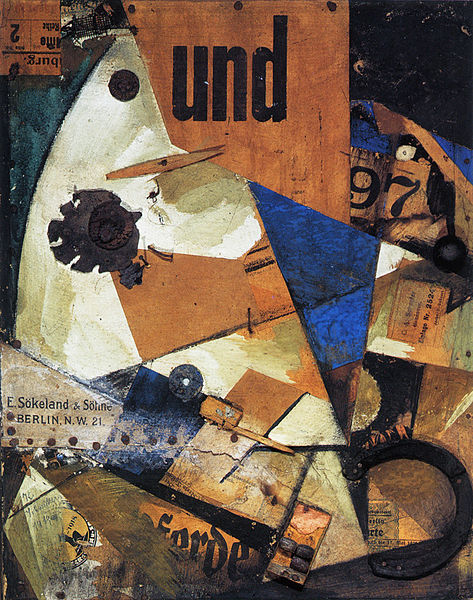

Kurt Schwitters, "Das Unbild" 1919

Collage can also be built up into more dimensionality with the addition of more and thicker paper or even other objects. Take a look at this interesting review of a current show of 20th century works in collage.

AssemblageWorks made with found objects that are not changed but are brought together into a new whole. The objects retain their original/unique identity and the new work emphasizes the connection between the found objects. (For example, works by Bettye Saar)

Bettye Saar, "Sunnyland (On the Dark Side", 1998 courtesy of the Brooklyn Museum

Bettye Saar is well-known for her assemblage (and collage) works that reference racism and feminism. I have been a fan for some years. In 2011 I visited a show called "Cage" at her New York Gallery and wrote a blogpost about it along with the work of her daughters, Lezley Saar and Alison Saar. You can see more examples of her work by clicking on the blogpost link.

More Assemblage
Joseph Cornell was perhaps the most famous artist to work mostly in assemblage by bringing together found parts, pieces and images and usually putting them into boxes that formed little worlds of their own.


Joseph Cornell, "Hotel Eden," ca. 1945, courtesy National Gallery of Canada, Ottawa.

Unlike Saar's more topical work, Cornell evoked an air of mystery with his strange juxtapositions and hidden allusions.

While Saar and Cornell are two of the most accomplished artists using this type of construction for their work, many unschooled and/or hobbyist artists are also drawn to the use or re-use of things they may have at hand. Some of these have a charming folk art quality, but others fail to achieve more than a desultory bringing together of disparate objects.

What Makes It Fine Art?
I think what separates "art" from "hobby" in creating assemblage works in particular is attention to formal elements of art making. This may be as simple as color or shapes of objects but these principles have to be made part of the work for it to succeed. For example, look at the arrangement of objects in the Cornell piece above: the unifying white color, the repeating square shapes, the repeating round shapes, the vertical lines broken by the diagonal white bar and the central focus of color on the parrot. This is an arrangement of forms in an illusionistic space.

There is also the issue of intention in creating the work. If the artist's intention carries too direct a message, the work may become trite.For example, if Cornell had inserted a sign saying "we are all caged" in the work above, it would have lost its air of mystery. If the artist tells the viewer what the work is instead of letting the viewer decide that for themselves, the artist is giving the viewer too much information and not provoking the viewer to reach his/her own conclusions. In more subtle work, viewers' interpretations may not match the intention of the artist, but the search itself provokes attention to the work Isn't that what artists all want - for people to pay attention to their work? Subtlety and universality of meaning seem to be learned skills.

BricolageWorks made with found or invented objects that are re-purposed, re-identified and subsumed into the new whole. The found objects are transformed by their inclusion in the new work. The work of art as a whole is more important than the individual parts and the parts themselves may be manipulated or changed before inclusion.

The difference between Assemblage and Bricolage can sometimes be a fine line, but I believe the amount of transformation the found objects undergo is where the distinction lies.


El Anatsui, "Ink Splash" (I am not sure of the title or date), probably about 8' H x 10' W

Close up of "Ink Splash"

Above you see a work by El Anatsui, that shows the piece as a whole and then a closeup of the individual folded bottle caps and pieces of bottle wrappings - all held together with thin copper wire. (I saw this show of his work at Jack Shainman Gallery in New York last January and wrote a blogpost about it that shows many more images of works. In fact, I am practically an Anatsui PR maven. If you search my Art in the Studio blog, you'll find it loaded with Anatsui posts.)

So, you see what I mean by the individual pieces being subsumed into the whole work?

Here is another artist whose work I admire:

Ted Larsen, "Two Reds Form a Slant," 2011, 14" x 3.5"

Ted Larsen, "Only Choice," 2012, 18" x 24"

Ted Larsen works in found painted metal, which I believe is mainly from salvaged cars.

Now here is some student work from the R&F workshop last summer.(I apologize for the bad iPhone photography, but I think you can get the gist of what is going on with this work.)


Work by Rita Klatchkin


Work by Barbara Winkel


Work by Deb Cole Townsend


Work by Laura Cave


Summary
Grasping the distinction between the three types of found object art takes some thinking and experimenting. I believe that our natural inclination is to focus on the individual identity of the found objects and to combine them in assemblage. Learning to use the objects in bricolage works of art means seeing the objects for their transformational possibilities as part of a larger whole. The objects may have to be taken apart to use their component parts, their color, dimensionality or some other aspect. The mental leap required may take a while to achieve but once there, the finished work can gain dimensionality and another level of interest. My workshop will help you to do this and to make some exciting work.

Sunday, September 25, 2011

A Work From The Sixties by Betye Saar


I saw this work in the daily email from Art Knowledge News and just had to post it. It was included in a show at the Getty Center in Los Angeles called "Pacific Standard Time: Crosscurrents in L.A. Painting and Sculpture, 1950-1970. Show dates were October 1, 2011 through February 5, 2012. Here's a link to the Getty's page about Betye Saar that includes a video of her talking about her work. She cites the Watts Towers and Joseph Cornell as specific influences but also talks about the artist as shaman and what viewers bring to art to complete its transformation.

The Getty site comments on the 1950-1970 period covered by this show:
...Los Angeles has shed its stereotype as the land of sunshine, palm trees, and movie stars to become an artistic powerhouse and an increasingly important international creative capital. This fundamental shift in the cultural landscape of the city dates back to the 1950s and 1960s, a period of critical importance in art history that has never before been fully studied and presented.


Too bad the show is long over.

Sunday, May 22, 2011

Manipulating the Elements

Betye Saar from the exhibition last December at
Michael Rosenfeld Gallery, "Cage"
(See my post about this show in Art in the Studio here.)


In my initial post I spoke about the difference--as I defined it--between bricolage and assemblage. Assemblage is the bringing together of various objects or pieces of materials as they are found, without much changing or manipulating of them. In this way, they retain their distinct identity as separate pieces although they become part of the whole.

I think the above work by Betye Saar is a good example of assemblage. You can see that she has brought together an old chair, washboard and cage together with other elements placed inside the cage. I see no evidence of paint or other manipulation of any of the parts. It looks like the pieces were incorporated into the work as she found them.

This work makes me very aware of the uniqueness of each of the objects and I wonder where they came from. That is, does Betye Saar go to flea markets or antique stores, does she have pickers working for her and so on. I think about the source of these elements because they appear to have survived over time and are more self-referential than otherwise. As I looked at the work, I understood that the combination of parts alluded to black slavery and got the evocative feel of the elements, but for me the work lacked the unique hand of the artist in its making. I thought the emphasis was more on the "found" than the "art."


Betye Saar, The Liberation of Jemima, 1972, 11 3/4"x8"x2 3/4"


The Liberation of Jemima is probably Betye Saar's most famous work. Her intention was to "transform a negative, demeaning figure into a positive, empowered woman..., a warrior ready to combat servitude and racism." (quote from Betye Saar). Here Saar has not just assembled found objects but transformed them by painting and attaching them to each other. She has made a Black Power fist from wood or some other painted material and set it in front of the found print of a black "mammy" with white infant. She has probably painted a found doll and painted found syrup labels, then set all the elements into a painted shadow box with fluffs of cotton in the foreground. This is a unified work that clearly speaks its meaning: Jemima has given up her broom for a gun and raised her fist in a Black Power salute. I would define this as bricolage.


Leonardo Drew, section of No. 75 at the DeCordova Museum
(See my post about this show in Art in the Studio here.)


Leonardo Drew is one of my favorite artists, as you may know from Art in the Studio. I saw this work in person at the DeCordova last September. It is choc full of found objects that have been assembled in a grid and painted with rust. What brings together the disparate shapes of the objects is the regularity of the small square blocks within each of the larger squares. This is grid upon grid organization. When the objects break the grid format because of their size and shape, the viewer's eye snaps right back to the grid with the appearance of the next block. Painting just about everything with rust has the effect of pushing everything back, toning it down so that it loses some of its original color and becomes part of the whole. That also gives it more of an old, decayed look. I would define this as bricolage.

When you see a collection of objects like this, is there any question about the meaning of it all?


Another piece by Leonardo Drew, this one hung in the grand staircase at DeCordova

This is a lovely little piece, maybe 2' by 2' or so. Here is a broken grid that still reads as a total grid, but look at how many ways he has disturbed the regularity of the format. 

Suppose you had a series of objects, not all the same shape and/or size, but a few the same, and you brought them together on a panel with a similar organization. Perhaps you would overlap other objects on some of them as Drew has done with things inside the little boxes. Inside=3D and Overlap=2D if you see what I mean. You could unify all the objects by painting them a similar color or colors, maybe hot pink or blue instead of rust. You would be manipulating the elements. You would be making bricolage.

Do I have to think about meaning?, you might ask. You will find your meaning from the objects, I would answer.


Found Object Art 
Yes, bricolage is "found object art," but if you google "found object art," you will get things that look like this:


Fear by Karen Hatzigeorgiou


Work by unidentified artist from Style Hive


Broken Family by Anthony Heywood, from My Modern Met


Found Object Art by Brad (age 5), from Barbara Bianchi


People who are not used to making art mostly tend to make animals, robots or doll scenarios from found objects. This is part of the folk art tradition, but this is not what we are aiming for.


Examples of bricolage from current exhibitions in New York galleries


Lisa Hoke at Elizabeth Harris Gallery, "Love, American Style", April 28-June 11
(thanks to Joanne Mattera for the link)


Love, American Style, Black and Gold, 2011, cardboard, paper, rivets, glue, 144 x  109 x 20 inches


Detail of above work


Panorama of the exhibition


Older work by Lisa Hoke:


Blue, 2007, plastic, paint and hardware, 25 x 27 x 3.5 inches


Zig, 2008, matchsticks, tissue paper, glue on cardboard, 5 1/4 x 6 x 3 1/4 inches


Boxed Sets, 2008, match boxes, paint and rivets, 14 x 12 x 10 inches


Louise Bourgeois at Cheim & Read, "The Fabric Works", May 12-June 25

While it may be stretching it to claim that some of these works are bricolage, look at the way she uses fabric to look like paint. The fabric elements of her compositions have certainly been manipulated, and compositions such as these would easily translate into more dimensional materials. Note the simplicity and clarity of her compositions, the balance between figure and ground and the breathing space in her work.

Addendum: By the way, I read on Altoon Sultan's blog that Bourgeois "found" these fabrics in her own closets, cutting them from clothing and household items. Read the excellent post about the show and see the more intimate photos of the show taken in person.


Eugenie Grandet, 2009, mixed media on cloth, suite of 16, 11 1/4 x 8 1/2 inches each


Untitled, 2006, fabric and fabric collage, 11 x 18 1/4 x 2 inches


Dawn, 2006, fabric book, 12 pages, 12 1/4 x 9 3/4 inches


Untitled, 2003, woven fabric, 34 x 44 inches

The last one is my personal favorite, probably because it has something African-looking about it.


----------------------------------------------------------------------------------------


By the way, if you Google "bricolage," you will get a lot of things in French, such as:


This is because the word "bricolage" is apparently used in French to mean "do-it-yourself."

-----------------------------------------------------------------------------------------

Next and last post before the conference: the wrap up, with emphasis on color, space, line, value, form and the rest of the components to consider in making fine art.

Sunday, April 17, 2011

Why Bricolage?

Bricolage is a term that is beginning to be used more frequently to describe artworks made from found, recycled or ready-made materials. Such material is usually called junk, but since we are talking about fine art,  I prefer to use a term which may be considered the equivalent of "collage" except that the materials are not necessarily paper and they are not necessarily attached with glue. Perhaps "assemblage" is a more familiar term for the process we will be using, but instead of just joining together elements or objects, I want to stress the manipulation of individual elements and the submersion of elements into a completed work.

-----------------------------------------------------------------------------------------------
NOTE: I am writing this blog for the students in my post-conference workshops at Truro Center for the Arts at Castle Hill on June 8 and 9, 2011. Those workshops are titled "Making Fine Art with Unconventional Mixed Media and Encaustic."  (See the full listings on the blog for The Fifth International Encaustic Conference.)  Each workshop lasts only a day and there is a lot of ground to cover.  I thought this blog might give us a head start by getting us thinking and communicating about using the process in advance.
---------------------------------------------------------------------------------------------------------------


This is a detail from a bricolage work by El Anatsui that is comprised of liquor bottle caps and wrappings. For more information on Anatsui's work, see my blog Art in the Studio.


Manipulation of Elements to Make a Whole
For example, in the bottle cap works by Anatasui, he has begun with found/recycled material but has transformed the material by cutting or folding the aluminum pieces into various shapes and joining them together with wire in different ways. He also sometimes shows the front of the materials and sometimes the backs. He uses found color to create pattern and shimmering effects. Notice, for instance, in the image above, that the elements have been shaped and that he has folded the corners of the strips on the right into triangles that show the silver backs of the strips. When this artwork is viewed as a whole, those silver triangles add to the shimmer and glow of the metal tapestry. The individual elements are formed into parts and organized according to a plan to make a work of fine art. You can still see the individual pieces and read the names of the liquors on close looking, and these close-up details make a more intimate connection for the viewer.


A view of one of El Anatsui's "tapestry" works made of bottle caps and wrappings. Untitled, 2007


The image below shows another way of Anatsui's folding the bottle wrappings so that even more of the back is visible. Also notice how strips are oriented in various ways so that striped patterns are created.


El Anatsui, detail from Fading Scroll


Where's the Encaustic?
Of course you will see that Anatsui does not use encaustic in his work and that the works are not attached to panels, canvases, paper or other supports. So perhaps you wonder what this work has in common with what we will be doing at Castle Hill.

My intention is to include images of works in this blog that are made from many different types of materials in addition to encaustic. I want to make the point that encaustic is just one of the elements you will be using to make the works and that the main use to which you will put encaustic is not that of a glue.  I hope that you will begin looking for examples of works that use found materials, examining how they are made and thinking about how you could include encaustic if you were to make a similar work.


Group Participation
I encourage you to post a comment with a link to bricolage works that you have made yourself or that have been made by others -- or you can email me images and I will post them to the blog. It would be nice if we could get a conversation going in advance of the workshops so that we will not be starting at square one and so that we can get to know each other a bit.


Future Topics
Other subjects that I plan to discuss on this blog are meaning or content in works of art and formal elements of composition. Perhaps you can suggest other topics that relate to bricolage?


Organization Method: The Grid
To begin our focus on organization of elements, here is another image of a bricolage work. This one is made of driftwood and other found elements that are organized in a grid. This organizing mode, first popularized in Cubist art, has become second nature to many artists. Here is a link to Joanne Mattera's post on grids and lattices in the galleries in February 2009. Perhaps you can imagine some of these pieces transformed into bricolage works.


This is Grid #3 by Bob Leibow. See more here.

So please feel free to comment, ask questions, make suggestions or send information. If you don't want to make a public comment, you can email me directly. My address is at the top right of the blog.