Showing posts with label El Anatsui. Show all posts

Monday, May 6, 2013

Bricolage at the Brooklyn Museum

I'm sharing a post here from Art Critical about an exhibition at the Brooklyn Museum by El Anatsui. I like the way the writer, Alex C. Moore, speaks about Anatsui's use of materials and the meaning Anatsui finds in them that relates to his own life, cultural inheritance and social movements. That's a lot packed into some discarded objects that shows the power of bricolage. Note that Anatsui uses the objects as raw materials from which to make his work. This is bricolage.


The Wall is Also a Story: (from Art Critical, the online magazine of art and ideas)
El Anatsui at the Brooklyn Museum
by Alex C. Moore

Gravity and Grace: Monumental Works by El Anatsui

February 8 to August 4, 2013
The Brooklyn Museum
200 Eastern Parkway
Brooklyn, NY, (718) 638-5000


El Anatsui, Gli (Wall), 2010. Aluminum and copper wire, installation at the Brooklyn Museum, dimensions variable. Courtesy of the artist and Jack Shainman Gallery, New York. Brooklyn Museum photograph.

El Anatsui’s exhibition at the Brooklyn Museum begins in the fifth floor rotunda with Gli (2010), a majestic installation comprised of four sheets of delicate metal rings that are suspended at various heights, inhabiting the space from floor to ceiling. Gli is an Ewe word that has multiple meanings: wall, disrupt, or story. An accompanying text elaborates that Anatsui was thinking of walls in Berlin, Jerusalem and Notsie when making this piece. Probably less familiar to many New Yorkers than the other examples, Notsie is a town in modern day Togo, West Africa, where according to oral histories, the Ewe people settled briefly before fleeing an oppressive ruler sometime in the 17th century. Reminiscent of chainmail, these hangings are solemn and haunting, conjuring the memory of powerful walls and ancient sorrows. Gli is torn and crumpled like a curtain in places, but as one moves around the space, the sheets shift and glimmer, becoming more solid and lively.

It is for these elegant and impressive bottle cap tapestries that Anatsui is most well-known and, unsurprisingly, they are the centerpiece of Gravity and Grace: Monumental Works by El Anatsui, an exhibition which originated at the Akron Art Museum in Ohio. The show demonstrates the range of Anatsui’s aesthetic—from the dense painterly abstraction of Black Block and Red Block (both 2010), to the gentle humor of Ink Splash (2010), and the seemingly precarious structure of Ozone Layer (2010) which flutters in an artificial breeze provided by fans hidden in the gallery wall, rattling like the gentle wheeze of an old smoker.

El Anatsui was born in Anyako, Ghana in 1944 and is a member of the Ewe ethnic group. In 1975 he moved to Nigeria to teach at the University of Nsukka, where he has resided ever since. After studying western sculptural traditions and methods at the University of Science and Technology in Kumasi, Ghana, Anatsui became interested in the indigenous forms and materials of his home country. He began to look at adinkra symbols and kente cloth–a weaving style practiced by members of his family–and one of his earliest pieces experimented with the wooden trays used to display food in the marketplace. From there he moved into other wooden, ceramic and recycled forms, often choosing materials associated with consumption, before discovering a bag of discarded bottle caps outside a local distillery and starting upon the explorations that led to his current work.


El Anatsui, Gli (Wall), 2010. Aluminum and copper wire, installation at the Brooklyn Museum, dimensions variable. Courtesy of the artist and Jack Shainman Gallery, New York. Brooklyn Museum photograph.

Earlier artworks such as the painted wood reliefConspirators (1997) allow the viewer a glimpse of how Anatsui’s work has developed and the common themes that run through his practice. The picture that emerges is of an artist who is interested in the mutability of forms, works arduously to explore and reinvent his materials, and transforms personal and historical narratives into form and content. A number of the artworks reference specific stories that warrant a closer look. Waste Paper Bags (2003), an installation consisting of seven grey forms, modeled on the large, red and blue stripped bags that are deceptively strong, and are a ubiquitous sight at a West African bus station or marketplace—the go-to bag for a woman with a heavy load or a long distance to travel. In Nigeria these bags are referred to as Ghana-must-go, harking back to a moment in the 1980s when an influx of Ghanaian refugees into Nigeria caused tension between the two groups. El Anatsui’s versions of the bag are large enough to house or transport a family, but too heavy to move. They are made of discarded aluminum printing plates that carry the stories of contemporary Nigerian life–newspaper articles celebrating new anti-malarial studies or a local political leader, school textbooks, wedding announcements and church pamphlets. The piece is the most monument-like of these monumental works, commemorating the rootless and sometimes uncomfortable position of an expatriate.


El Anatsui, Gli (Wall), 2010. Aluminum and copper wire, installation at the Brooklyn Museum, dimensions variable. Courtesy of the artist and Jack Shainman Gallery, New York. Brooklyn Museum photograph.

Like the trash that El Anatsui uses as raw materials, the difficult historical relationships associated with Gli, Waste Paper Bags, and the bottlecaps themselves (a token reminder of the Atlantic Slave Trade) are present in the galleries, but do not overwhelm our sensory experience of the work. Instead, memory and history are transformed into a celebratory occasion. The eponymous piece in the show is one of the largest of the tapestries, measuring 145 5/8 x 441 inches. As with all his work, Anatsui wields his deceptively simple palette masterfully, building blocks of colors with subtle care and changing the direction and rhythm of the weave as a painter would carefully choreograph her brushstrokes. A red form pulsates outward across the space, meeting a cool continent of silver and yellow. Suggestive of a pinwheel, a sunset, or a flower, the energy is vibrant and expansive. It is not a finished statement, but a ball of potential energy thrown up against a wall, continually growing and shifting, adjusting to circumstances with gravity and grace.

(Thank you Alex Moore and Art Critical.)

Sunday, April 21, 2013

Thinking About Bricolage

I am gearing up for my two-day workshop on May 28 and 29 at Castle Hill Center for the Arts in Truro, Mass. in conjunction with the Seventh Annual International Encaustic Conference. This year, for the first time, Bricolage: Making Fine Art With Found or Recycled Materials and Encaustic will be a two-day workshop preceding the encaustic conference. I have expanded it to two days to give students more time to think about the concept of bricolage, make examples of work and present them to the class for discussion and critique. Having the opportunity to make several examples results in a big difference to students. I saw this last summer when I was a visiting artist at R&F Paints and able to extend the bricolage workshop to three days.

There are three places left in the class and you can sign up here.)

What is bricolage, anyway?

Last year I did some thinking about collage, assemblage and bricolage and defined for myself what the differences were between three types of art that use found, recycled or invented objects.

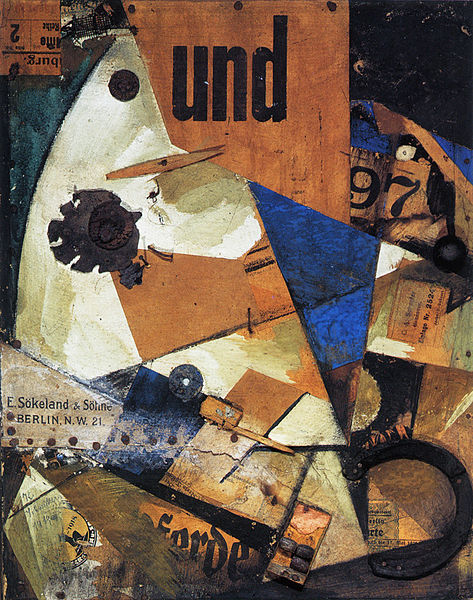
CollageWorks made using paper or fabric and glue, or also using wax as glue. Collage is basically two dimensional in this more traditional definition.

Picasso and Braque were two early practioners of this genre, but perhaps the most famous 20th century "collage artist" was Kurt Schwitters. Note that gluing paper into the composition is probably the most important aspect of collage but paint, charcoal and other additions may also be incorporated.


Kurt Schwitters, "Das Unbild" 1919

Collage can also be built up into more dimensionality with the addition of more and thicker paper or even other objects. Take a look at this interesting review of a current show of 20th century works in collage.

AssemblageWorks made with found objects that are not changed but are brought together into a new whole. The objects retain their original/unique identity and the new work emphasizes the connection between the found objects. (For example, works by Bettye Saar)

Bettye Saar, "Sunnyland (On the Dark Side", 1998 courtesy of the Brooklyn Museum

Bettye Saar is well-known for her assemblage (and collage) works that reference racism and feminism. I have been a fan for some years. In 2011 I visited a show called "Cage" at her New York Gallery and wrote a blogpost about it along with the work of her daughters, Lezley Saar and Alison Saar. You can see more examples of her work by clicking on the blogpost link.

More Assemblage
Joseph Cornell was perhaps the most famous artist to work mostly in assemblage by bringing together found parts, pieces and images and usually putting them into boxes that formed little worlds of their own.


Joseph Cornell, "Hotel Eden," ca. 1945, courtesy National Gallery of Canada, Ottawa.

Unlike Saar's more topical work, Cornell evoked an air of mystery with his strange juxtapositions and hidden allusions.

While Saar and Cornell are two of the most accomplished artists using this type of construction for their work, many unschooled and/or hobbyist artists are also drawn to the use or re-use of things they may have at hand. Some of these have a charming folk art quality, but others fail to achieve more than a desultory bringing together of disparate objects.

What Makes It Fine Art?
I think what separates "art" from "hobby" in creating assemblage works in particular is attention to formal elements of art making. This may be as simple as color or shapes of objects but these principles have to be made part of the work for it to succeed. For example, look at the arrangement of objects in the Cornell piece above: the unifying white color, the repeating square shapes, the repeating round shapes, the vertical lines broken by the diagonal white bar and the central focus of color on the parrot. This is an arrangement of forms in an illusionistic space.

There is also the issue of intention in creating the work. If the artist's intention carries too direct a message, the work may become trite.For example, if Cornell had inserted a sign saying "we are all caged" in the work above, it would have lost its air of mystery. If the artist tells the viewer what the work is instead of letting the viewer decide that for themselves, the artist is giving the viewer too much information and not provoking the viewer to reach his/her own conclusions. In more subtle work, viewers' interpretations may not match the intention of the artist, but the search itself provokes attention to the work Isn't that what artists all want - for people to pay attention to their work? Subtlety and universality of meaning seem to be learned skills.

BricolageWorks made with found or invented objects that are re-purposed, re-identified and subsumed into the new whole. The found objects are transformed by their inclusion in the new work. The work of art as a whole is more important than the individual parts and the parts themselves may be manipulated or changed before inclusion.

The difference between Assemblage and Bricolage can sometimes be a fine line, but I believe the amount of transformation the found objects undergo is where the distinction lies.


El Anatsui, "Ink Splash" (I am not sure of the title or date), probably about 8' H x 10' W

Close up of "Ink Splash"

Above you see a work by El Anatsui, that shows the piece as a whole and then a closeup of the individual folded bottle caps and pieces of bottle wrappings - all held together with thin copper wire. (I saw this show of his work at Jack Shainman Gallery in New York last January and wrote a blogpost about it that shows many more images of works. In fact, I am practically an Anatsui PR maven. If you search my Art in the Studio blog, you'll find it loaded with Anatsui posts.)

So, you see what I mean by the individual pieces being subsumed into the whole work?

Here is another artist whose work I admire:

Ted Larsen, "Two Reds Form a Slant," 2011, 14" x 3.5"

Ted Larsen, "Only Choice," 2012, 18" x 24"

Ted Larsen works in found painted metal, which I believe is mainly from salvaged cars.

Now here is some student work from the R&F workshop last summer.(I apologize for the bad iPhone photography, but I think you can get the gist of what is going on with this work.)


Work by Rita Klatchkin


Work by Barbara Winkel


Work by Deb Cole Townsend


Work by Laura Cave


Summary
Grasping the distinction between the three types of found object art takes some thinking and experimenting. I believe that our natural inclination is to focus on the individual identity of the found objects and to combine them in assemblage. Learning to use the objects in bricolage works of art means seeing the objects for their transformational possibilities as part of a larger whole. The objects may have to be taken apart to use their component parts, their color, dimensionality or some other aspect. The mental leap required may take a while to achieve but once there, the finished work can gain dimensionality and another level of interest. My workshop will help you to do this and to make some exciting work.