Showing posts with label post-conference workshop. Show all posts

Saturday, May 5, 2012

Oh, those mystery boxes!

I've been really slacking off on this blog because I've been too busy making work in bricolage all year. Since actually being in the studio making work is my priority, something had to suffer the consequences. Unfortunately, this blog was it - low blog on the totem pole. But now I guess I had better write a post seeing as The Conference with its Pre and Post workshops are nearly upon us. In the far reaches of the studio the Mystery Boxes have begun shuffling around and gathering their contents. Okay, okay, I hear you.


Mari Skarp, The Goat, 2008, wood, found objects, paper, rubber,
handspun wool, goat horns. Mari Skarp's bricolage work with wax
will be included in my talk at The Conference.


Wax + Bricolage Talk at The Encaustic Conference
This year I am doing a lot more research about bricolage than I have done previously in preparation for my talk on Friday, June 1st, at The Sixth International Encaustic Conference in Provincetown, Mass.  Perhaps the topic should actually be written "Bricolage + Wax" as I have found that examples abound of bricolage but work with wax is relatively more difficult to locate. I have been scouring the web to discover strong work that illustrates my definition of bricolage and have collected some wonderful examples.


Mari Skarp, Carriage, 2008. Welded steel, found objects, fabric, rubber, wire,
barren sunflower heads, photo of artist's great grandmother.  mariskarp.com

My Definition of Bricolage Revised
Looking at so much work that can be described as bricolage (with and without wax) has led me to revise or expand on my definition. Previously I had only been emphasizing the difference between bricolage and collage. I was focusing on the additional dimensionality of bricolage when compared to collage and, somewhat snarkily, calling it "muscle." Turns out some people interpreted that to mean I was claiming only bricolage had muscle, and that all other art forms lacked heft and robustness when compared to it.


Mari Skarp, Rocking Horse, 2008, welded steel, found objects,
wire, wood, horsehair.


First off, it was not my intention to dis other art forms. Secondly, I think a more meaningful definition of bricolage would also take into account its difference from assemblage or found object art. I had a hard time formulating what this difference was, but I think I finally have it:

In bricolage, the identity of individual objects is subsumed into the whole of the work. Individual objects are re-purposed and re-identified as part of the whole.

At the same time, the individual objects add a layer of meaning or content to the work as a whole because of their unique identities (which may be discovered on looking closer).

I will be talking more about this expansion of my definition and showing examples of what I mean during my talk.


Now About Those Boxes
Yes, I am getting the boxes ready for my Pre-Conference workshop on Wednesday, May 30th, and for my Post-Conference workshop on Thursday, June 7th. These workshops will be held at the wonderful Truro Center for the Arts at Castle Hill. Last year, if you recall, I had the boxes absolutely packed with all kinds of stuff -- much more than could ever be put on the dinky panel I supplied. I wanted to emphasize how much working with found objects depended on editing and choosing what to include. I was hoping that all my emphasis on organizational approaches to making art would help students to pull together a work that became more than "a bunch of stuff with wax on a panel ."


An action scene from one of last year's workshops showing students
opening their boxes and examining the contents. (Donna Ramsey Nevers and
unidentified hands.)

I think some students were able to conquer the over-abundance of materials that I supplied, but many had a lot of difficulty choosing what to use and packed too much on the panel. Finding a theme in the midst of all those objects also presented a problem for some.

The New Challenge
So this year, I am organizing the workshops differently. I will still have an abundance of materials and equipment (and encaustic) available for students to use, but in each Mystery Box I am only putting two panels and five or six objects -- the same objects in each box. So the challenge this year is for each student to take those same objects, use them all or only some of them, and make a strong work on one panel.


We had a lot of laughs and fun last year. Here are Donna Nevers, Joanne
Mattera, Sherrie Posternak and Binnie Birstein yucking it up.

I will also provide a list of possible themes that students might use. This list is to counteract the problems some students had last year in understanding the difference between broader, more conceptual themes and literal illustrations. With this list, I am attempting to help students think about conceptual contexts for their works.


The happy face of Peggy Epner after last year's workshop.

Then, students will have the second panel to make another work with the benefit of compositional knowledge gained from the first piece. And it will all be capped with our mini show and discussion of the works completed. Whew! Sounds like a full program. And with plenty of time-outs for laughing.

Monday, June 13, 2011

Class Results from the Post-Con Workshops: Thursday


A bricolage with encaustic work by Joanne Mattera.
This calls for a series, in my opinion.

Thursday's post-con class in Unconventional Mixed Media With Encaustic was a bit wilder and more rambunctious than Wednesday's class. Besides Joanne, students included Cherie Mittenthal, Binnie Birstein, Lynette Haggard and other friends, as you will see below, and of course it was a real pleasure (and challenge) to have them take my workshop.


Opening the boxes


Joanne was very pleased with a Betty Crocker Cookbook

The process was the same for this group of students as it was the day before. This class, however, wanted to work in multiples, so several people made more than one work.


There was a lot of laughter and everyone seemed to be having a great time.

Now on to the work:


Binnie Birstein (Did I say "everyone" was having a good time?)


Binnie's work


Cherie Mittenthal


Cherie's work 1

Cherie's work 2


Gurli Lovinger

Gurli's work


Donna Ramsey Nevers (aka Donna Two)

Donna's work 1


Donna's work 2

Donna Talman

Apparently I missed taking a photo of Donna Talman's work by itself, but it's the piece right beside her with the rust-colored top. She also did a second one which I neglected to photo as well. Sorry, Donna!


Fay Senner


Fay's work

Joanne Mattera


Joanne's work 1


Joanne's work 2


Joanne Powell

Joanne's work


Lynette Haggard


Lynette's work

Nancy Natale


Nancy's work


Patricia Palmer


Patricia's work


Patti Russotti


Patti's work 1


Patti's work 2


Sherrie Posternak


Sherrie's work


Virginia Lamb


Virginia's work

This class also found that knowing when to stop adding elements and undercutting the focal point of the work was the most difficult part of this process. Deciding what was important in terms of meaning or intention and then emphasizing or building around that concept visually was the stumbling block for most people. It seems that it's very easy to get distracted by falling in love with particular objects and wanting to add them in. In my conversations with people during the construction process, I tried to emphasize the importance of leaving areas of the work uncluttered and spatially open.

The other main problem, I would say, is being too literal with meaning so that the work becomes more an illustration of a statement or theme rather than an aesthetic composition. This can be a fine line to walk but usually resorting to formal components of visual organization can assist the process.

Thank you to all the Thursday students for a great day of art making and laughter!

These post-con classes were a wonderful experience for me and an opportunity to test some ideas about how to assist students in creating mixed media works with encaustic. Thanks so much to Joanne and Cherie for the opportunity to put my theories into practice.

Sunday, June 12, 2011

Class Results from the Post-Con Workshops: Wednesday

A bricolage work by Jan Baugher from Wednesday's class

On Wednesday, June 8th, and Thursday, June 9th, students in the all-day workshops on Making Fine Art With Unconventional Mixed Media and Encaustic worked with the mystery boxes and other materials I provided to make works of art. The idea was that the Art of Bricolage blog would provide some insight into the process of combining found objects with encaustic and prepare students for the process.


Opening the boxes


First, there was the anticipation of opening the mystery boxes to see what they contained. I told the students that there was much more in the boxes than they could ever use in one work on the 9" x 12" panels I provided. In addition to the contents of the boxes, there was a selection of other materials to use such as paper, fabric, colored Evans encaustic gesso, pigment sticks, oil pastels, watercolors, string, wire, thread, and who knows what-all. There were eight prepared colors of R&F encaustic paints plus a large pot of clear medium.


Holding up a Barbie and a green stuffed animal


Examining contents


Before we began, I read a list of the five steps I thought they would have to use in the process:

1) Examine contents and think about alternative ways they could be used and/or transformed
2) Edit - review the materials in the mystery box, rejecting some and selecting others
3) Make a provisional composition - lay out elements on the panel to see how they could work together
4) Plan construction sequence - decide what to do about the panel itself and in which order the elements should be assembled. Remember that once you use wax, you will not be able to glue.
5) Execute plan - you can improvise and change as you go.


That sounds simple enough, but I don't know anyone who would actually be able to stick to as simplistic a list as that. In actuality, artists seemed to make several provisional compositions as they tried out a scheme and became familiar with the elements. In the end they may have rejected everything they started with in favor of all new things. This was not an easy process - as we all learned.


Before the boxes were opened, I also asked the students to write a two-sentence statement as they worked on their piece. One sentence was to be about the physical construction and the second about their meaning or intention for the work. The plan was to stop working by 2:45 p.m., hang up all the work, rearrange it into the semblance of a show and then have each person stand by their work and present it to the class with their statement about it. After everyone had a turn, we had a group discussion of the process and what we had learned about working this way.

Here are the students and their works (not the world's greatest photography but you can get a sense of what they made):


April Nomellini 


April's work


Bet Kindley

Bet's work


Carol Bajen-Gahm

Carol's work


Diane Destiny


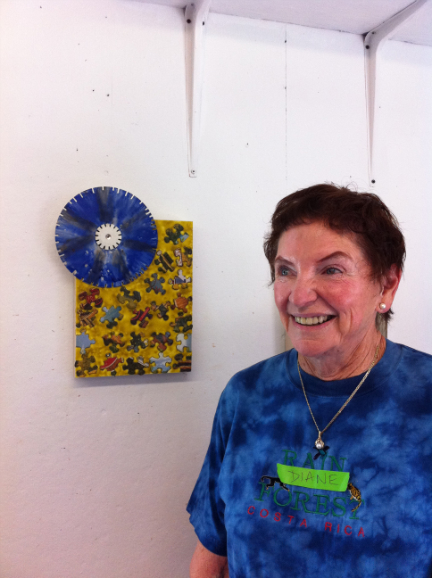
Diane's work


Esther Kirschenbaum


Esther's work


Jan Baugher

Jan's work

Judy Klich

Judy's work


Karen Frazer


Karen's work


Otty Merrill


Otty's work


Peggy Epner


Peggy's work


Susan Lasch Krevitt

Susan's work

I was very pleased to see the quality of this work. The most important factor for most people was knowing when to stop. The temptation was to keep adding elements just because they were available and putting on the brakes was hard to do.

Thank you to everyone who participated in this class. I had a great time and I hope you did, too!