Showing posts with label The Brooklyn Rail. Show all posts

Saturday, December 7, 2013

Using Metaphor in Art (Especially in Bricolage)


Arthur Simms, "Globe, The Veld" (2004).
Metal, Wire, Plastic, Artist's Nails, Wood, Objects, 17" by 14"by 14".
Text by Peter Orner. Courtesy of the artist.

This morning I was reading the review of  "Come Together: Surviving Sandy" by Roberta Smith in the New York Times. This is a big exhibition of work by 300 artists who survived and were affected by Hurricane Sandy (The show is currently on through December 15 in Brooklyn. See the link for details.) Roberta Smith mentioned an outstanding work in the show, a 1995 piece, “To Explain, Expand and Exhort, to See, Foresee and Prophesy, to the Few Who Could or Would Listen”  by Arthur Simms. She said that it should have been in a museum collection by now. 
I went looking on Google to see Arthur Simms' work as I was unfamiliar with it, and I discovered that Arthur Simms is a sculptor who uses the technique of bricolage to transform found objects into art by combining them in particular ways. (You can see some of his spectacular sculpture on his website.)
Previously I have written about the difference between bricolage and assemblage: while assemblage emphasizes the identity of the individual objects, the objects in bricolage lose their individual identity and are subsumed into the whole of the work. The objects or pieces become parts of a new whole that is the artwork. But what is the meaning of such transformation? Why do artists use found or repurposed objects in their work?
My search for Arthur Sims also turned up an interview with Simms by Phong Bui of "The Brooklyn Rail. ") What I found was the usual very insightful interview by Phong Bui, but it really spoke to me about the metaphors inherent in art, some of which artists focus on and others that are simply too ordinary to even be recognized per se. I hope you will read the whole interview, but here are some highlights about metaphors in Simms' work.

Arthur Simms, "Caged Bottle" (2006).
Rope, Wood, Glue, Bicycles, Metal, Bottles, Wire,
50 by 62" by 36". Courtesy of the artist.

Rail: It’s your identification with the materials, therefore allowing the alchemical process to take place. This is a strong belief that Martin Puryear has always insisted on, even at the expense of what comes and goes in the art world.

Simms: Yeah, I love his work man. His retrospective at the MoMA in 2007 was an important experience for me. In fact my piece, “Hemp Or If I Were A Bird,” (1991) is an homage to both Martin Puryear and Constantine Brancusi, whose work he admires for the same reason we are talking about. Like them, it’s the transformation that excites me most. People have asked me, “Why do you choose certain objects?” and I have said, “well, maybe because it’s shiny, rusted, has a certain color or patina,” and so on, or maybe it references my background and a million other things. Whatever the reasons may be, once they’re chosen and find their ways into the work, they take on into another life. So, as you had just said, it’s about alchemy
Rail: "...the way you tie things together is essentially a form of wrapping, which is interesting in that it is similar to the way in which, let’s say, polite language wraps social interaction, architecture wraps space, or how people in Asia, particularly in Japan, take extreme care in wrapping objects, whether it’s groceries or gifts. Or how the dead bodies, depending on their socio-political-religious ranking, are wrapped as part of the process of mummification, which was considered a passage to the after-life, as in Ancient Egypt, for example. Do you see your work as a wrapping ritual that transcends the mundane, in this case, found and used objects, to some form of transcendence?"

Simms: Yes, I do. It’s like a skin that has energy. To me, the rope is like lines as in drawing, an activity that I do more than sculptures. I’m drawing with the rope obsessively until it becomes a sort of skin over all these various things that are on the inside, which you can barely see. Later on I started using wire as a different kind of skin..

Arthur Simms, "Buddha" (2008). 81" by 50" by 52"
Wire, Bottles, Bamboo, Wood, Metal, Ice skates, Wheels.
Courtesy of the artist.


Rail: Like a painting that has been painted over so many layers that you can see its accumulated history on the surface but you can’t see what has been buried underneath. At any rate, in citing the found materials that you use in your work, which are basically everything from milk crates, plumbing parts, old shoes, rags, bottles, and cans to various objects such as hand tools and so on, it reminds me of the bower bird, especially the male, which, to attract its mate, often builds a bower with a variety of materials such as feathers, stones, broken shells, and leaves, mixing them with discarded plastic items, coins, nails, pieces of glass, and so on. And this selection of various materials is what makes up the bower, and one is never identical to the next. This is what some ornithologists called the “transfer effect.” In other words, do you have a general idea that relies mostly on a spontaneous process in which the image is gradually formed? Or do you make drawings beforehand?

Simms: No, I never make a drawing beforehand. I always consider my drawing as something in and of itself. I don’t make sketches or little maquettes of the sculpture mostly because I enjoy the improvisational aspect by keeping the two activities of drawing and sculpture independent. But as far as your reference to the bower bird, I had looked at and admired many birds’ nests at the Museum of Natural History like I do with other natural occurrences, things that are made by different creatures and insects. It’s all open and all there for any one of us to take and use accordingly in to our works.

-------------------------------------------------------------

I will be including images of Arthur Simms' work in my talk on bricolage at the 2014 International Encaustic Conference in Provincetown in June.


Sunday, September 18, 2011

John Outterbridge

Artforum Newsletter (an online newsletter) of September 16, 2011 had an interesting 500-Word piece about John Outterbridge, a Los Angeles artist with a long history of making work from found, recycled and discarded objects, i.e. bricolage. Students of bricolage, please note that the material (rags) that Outterbridge uses is where he begins, but he reaches way beyond that in relating his meaning and intention in the work. I'm quoting the whole piece from the AF Newsletter below.


John Outterbridge, The Rag Factory (detail), 2011, mixed media, dimensions variable. Installation view

For “Pacific Standard Time,” the multisite initiative that runs from October 2011 to April 2012 and celebrates art made in Southern California between 1945 and 1980, the artist John Outterbridge has created a site-specific installation at LAXART made almost entirely out of rags collected from the streets of Los Angeles and from a downtown factory. Widely known as a teacher, mentor, and community organizer, and as the director of the Watts Towers Arts Center from 1975 to 1992, Outterbridge has made work for the past forty years that is widely associated with the California Assemblage movement. The show is on view from September 10 to October 22.

I SEE A RAG AS AN OBJECT OF MANY VIBRATIONS. You wear clothes, and after you’re tired of them, they’re just rags. But you can’t escape the importance of the rag, no matter where you go or what you do. We use them to wrap around our bodies, but we also hide in them. Because of the colors, because of their previous lives and their histories, rags are pretty much a statement about our social position in the world and the importance of the cast-off. I like using metal a great deal too, or really any material that has a voice. Rag is not as cold as metal, and you can fold it up and put it in your pocket, you can put it in a bundle, you can hang it from the ceiling, you can decorate with it, it becomes a pillow you can lay your head down on. And that’s why I chose not to use anything for this show but piles of rags.

I was born in 1933, a long time ago. When I was a kid growing up in North Carolina, I had a mother and a father who had a lot of faith in cast-offs, the beauty and the aesthetics of what is not of use anymore, and that has always excited me because I saw old fences, degraded buildings, and scrub rags not as foreign objects but as being of a piece in the language of life, each with a lot of kinship between them. When you grow up the way I did, the way most African Americans did, separation was the law, and there were certain things––many things––that you just couldn’t do. We don’t talk about race in the way that we should, because it’s not popular anymore. We think that everything has been done before––even though nothing has been done before.

You bring that in your studio with you, that anger, whatever knowledge you gain from it. You don’t just do art; art becomes your life. The creative expression, whatever you’re doing—the fact that you have to go on the sidewalk and protest, and sometimes you have to break a glass window—it becomes part of your creative gesture, and it becomes part of your art. There is a little time to separate the act of doing art and act of going into life. And sometimes you’re not capable or able to speak of it, simply because you choke up, when you have to get into the past.

I feel good about the use of rag as an expressive element, but I don’t see it as different from other aspects of my life, or the way I think about a general population, a world population. Rags have always been in and around the environments I’ve been a part of. With me, art has the audacity to be anything it needs to be at a given time. Anything. Because the creative process is the beginning of all things, no matter what we’re doing or where we are going. You just can’t get away from rag; even when you throw it away it comes back to you. It’s like water, nourishing to your character, to the character of the cast-off, and to the way we practice living.

As told to Allese Thomson Baker


John Outterbridge, Traditional Hang-Up, Containment Series, 1969. Mixed media, 30" x 25"

Note: All photos in this post except the first one (from the Artforum article) are by Tilton Gallery, New York © John Outterbridge

More About Outterbridge
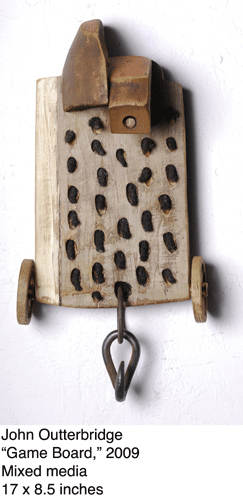
John Yau in The Brooklyn Rail also wrote a piece in 2009 on Outterbridge when he had his first New York show at Tilton Gallery 8. Students of bricolage, please note that Yau speaks about the wider context of Outterbridge's work in terms of artists and writers with related ideas and also about the meaning of Outterbridge's intention and the wider meaning of his work. I'm quoting an excerpt from Yau's article below:


Long before it was fashionable to do so, Outterbridge recognized that identity is a construction, not a given, and certainly not something to be defined by succumbing to external pressures. In this regard, Outterbridge’s philosophical-aesthetic position has affinities with Theresa Hak Kyung Cha (1951-1982), Ed Clark, David Hammons (whom Outterbridge mentored in L.A.), Martin Puryear, Alma Thomas (1891-1978), and Stanley Whitney, artists and writers who do not utilize any of the familiar and ultimately reassuring racial markers to make quickly readable work that announces their identities. Rather, Outterbridge’s relationship to art history, including non-Western art, and personal history (Rodia’s monumental assemblage, for example) is complex, and does not fit into any of the overarching narratives used to categorize all art. The death of the artist and originality, as well as the emergence of deskilling and art that is supposedly anti-market, are not only irrelevant when it comes to Outterbridge’s work, but they are also exposed for their repressive nature—they too are manacles.


One of the central subjects in this exhibition is Outterbridge’s belief that art has the power to heal and to curse. In two otherwise very different wall pieces, Asafetida Yoke (2008) and Hinged Window with Asafetida Bags Branded (2009), the artist includes a tiny bag or bags tied tightly at one end. In African American Hoodoo, which should not be confused with voodoo, asafetida can be used for magic spells as well as for protection. By introducing these and other elements into his work, Outterbridge reminds us that in some cultures the function of art is not purely aesthetic or formal. Moreover, in his work, which often incorporates a wide range of detritus, from pieces of wood, wire, rags, tool parts, unrecognizable things, and hair, Outterbridge both uses and fashions his materials, all in the service of transforming them into something more than what they once were.

Formally, Outterbridge’s unearthings echo the subject of his work, which is the excavation of different histories that have been covered over, neglected, and hidden. He possesses a masterful ability to join delicate things (a tiny painted bell) to larger, sturdier things, which are often rusted, patinaed by time. Their power to endure time’s corrosive vagaries, to survive and become transformed, is the eloquent testimony suffusing all of the work.


John Outterbridge, Ragged Bar Code, 2008, Mixed Media 58" x 8" x 2 1/2"

In Ragged Bar Code, the artist wrapped twigs with brightly colored scraps of cloth and mounted them vertically in a horizontal line across the wall. A form of identification, barcodes compress data into a visual abstraction; as the poet Christopher Dewdney has advanced, one recent manifestation of them is tattoos.Ragged Bar Code is dense with data, all of which we have to translate. Inviting intimacy—I was tempted to touch the bits of cloth as if they possessed talismanic power—Outterbridge’s work conjures complex, multilayered narratives that are viscerally and visually enchanting. Having made a real and important place for himself in postwar American art, he continues with unparalleled grace to implicitly challenge many assumptions regarding the proper place and meaning of art in postmodern culture.